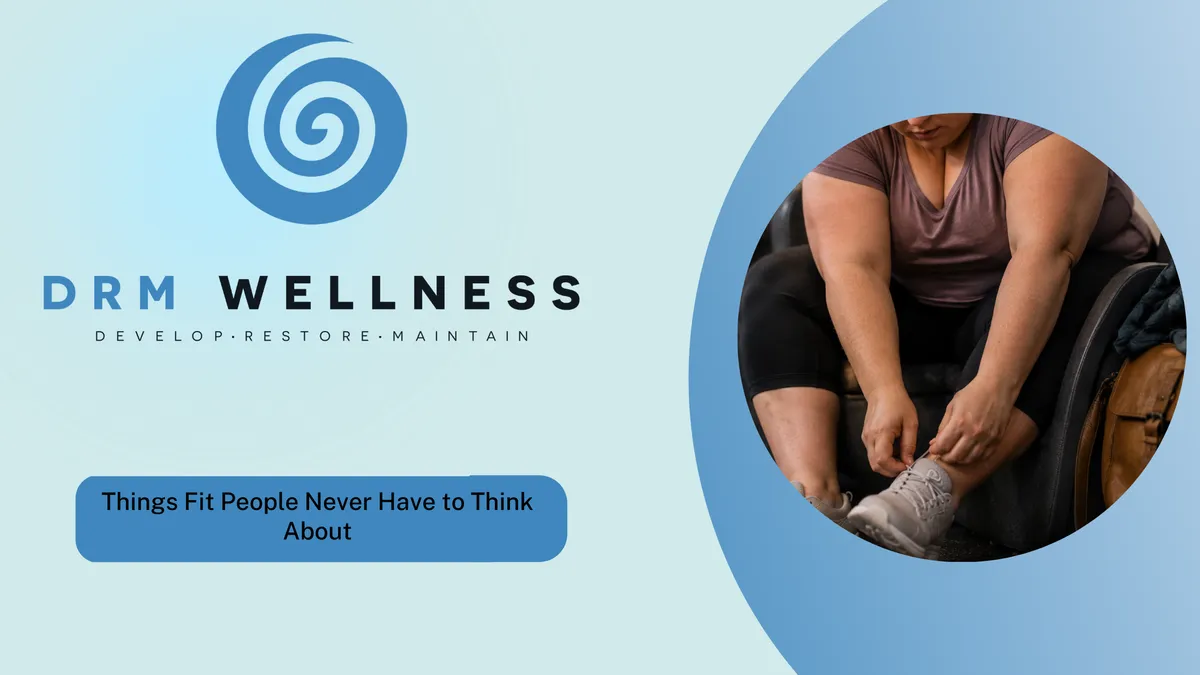
Things Fit People Never Have to Think About
The internet is an amazing place.
With a few taps on a screen, we can learn a new skill, connect with people around the world, find answers to almost any question, and access more information than any generation before us.
Unfortunately, the internet can also be a place where people hide behind keyboards and say things they would never say face-to-face.
At DRM Wellness, we work hard to create something different.
Whether we're posting silly TikTok videos to make you laugh, sharing educational content about health and wellness, or writing blogs like this one, our goal is simple: to create a space where people of all sizes feel welcome, respected, and supported.
We believe movement is for every body.
We believe wellness should be accessible to everyone.
And we believe people deserve information without judgment.
As an occupational therapist, fitness professional, and someone who has personally lived in bodies of many different sizes, I've seen both sides of this conversation. I've been everything from a size 6 to a size 26. I've experienced what it's like to move through the world when fitness feels easy and when it feels incredibly hard.
One thing I've learned is that many people simply don't realize the extra challenges that can come with living in a larger body.
Not because they're bad people.
Not because they don't care.
Simply because they've never had to think about them.
This article isn't about blame, guilt, or creating an "us versus them" conversation.
It's about understanding.
It's about recognizing that two people can walk into the same gym, the same doctor's office, or the same fitness class and have completely different experiences.
So, in the spirit of education, empathy, and a little perspective, let's talk about some of the things many fit people never have to think about, but that many people in larger bodies navigate every single day.
For some people, exercise starts with a workout. For others, it starts with overcoming anxiety.
"Just go for a walk."
"Just join a gym."
"Just start moving more."
The word just gets thrown around a lot when it comes to fitness.
Most people mean well when they say it. They're trying to be encouraging. They want to help.
But sometimes that one little word overlooks an important reality:
Not everyone starts their fitness journey from the same place.
For some people, putting on a pair of sneakers and heading to the gym is no big deal. They don't spend much time thinking about whether they'll fit on the equipment, whether people will stare, or whether they can even find workout clothes that fit comfortably.
For many people in larger bodies, however, those concerns are very real.
Before the workout even begins, there are often barriers, worries, and decisions that most people never have to consider.
Let's talk about a few of them.
The Equipment Question
Imagine walking into a fitness center for the first time.
Most people are thinking about which machine they want to use first or whether they'll survive leg day.
Some people are wondering something entirely different:
Will this equipment hold me?
It's not a pleasant thought, but it's a common one.
Treadmills, exercise bikes, weight benches, and other equipment often have weight limits. While many modern facilities offer equipment that accommodates a wide range of users, not every facility is created equally.
For someone who has previously encountered a weight limit on a chair, a ride at an amusement park, or a piece of exercise equipment, that concern can linger.
Instead of focusing on getting stronger, they're focused on whether the equipment was designed with their body in mind.
That's a very different starting point than simply deciding which machine to use.
The Chair Scan
Have you ever walked into a room and immediately evaluated every chair?
Many people haven't.
Others do it every single day.
Waiting rooms, conference rooms, restaurants, sporting events, community meetings, and fitness classes can all involve a quick mental assessment.
Which chair looks sturdy?
Which chair has arms?
Will I fit comfortably?
Will it be difficult to stand up afterward?
Will it squeak or creak?
While it may seem like a small thing, these constant calculations create a mental load that many people never have to carry.
It's exhausting to always be evaluating your environment before you can relax and participate.
Exercising in Public Can Feel Vulnerable
One of the most common concerns I hear from fitness clients has nothing to do with exercise itself.
It's the fear of being watched.
People worry about being judged for how they move, how fast they walk, how much they sweat, or how quickly they become tired.
They worry about looking awkward.
They worry about doing an exercise incorrectly.
They worry about standing out.
For some people, taking a walk around the neighborhood or stepping into a gym feels routine.
For others, it can feel like stepping onto a stage where everyone is watching.
The reality is that most people at the gym are paying far more attention to themselves than anyone else.
They're checking their own form in the mirror.
They're looking at their own workout plan.
They're wondering if they remembered to pay the electric bill.
They're trying to figure out why the treadmill is making that weird noise.
But knowing that logically and feeling it emotionally are two very different things.
If you've had negative experiences in the past, your brain remembers. And it often tries to protect you by convincing you not to put yourself in a situation where you might feel embarrassed again.
The good news is that gym culture is slowly changing.
More people are recognizing that fitness should be for everyone, not just people who already look fit.
One person who deserves a lot of credit for helping shift that conversation is Joey Swoll. He is the self proclaimed “ CEO of GYM POSITIVITY” https://www.instagram.com/joeyswoll/
If you've spent any time on social media, you've probably seen his videos calling out people who mock, film, or shame others at the gym. His message is simple: if someone is trying to improve themselves, they deserve respect.
Period.
Whether they're lifting 500 pounds or walking on a treadmill for five minutes.
Whether they're a size 2 or a size 26.
Whether they're training for a marathon or simply trying to move more than they did yesterday.
That message matters.
Because every person in the gym is there for a reason.
They're trying.
They're learning.
They're improving.
And that should be celebrated, not criticized.
The vast majority of gym-goers are supportive people who remember what it was like to be beginners. Most fitness professionals genuinely want to help. Most people are rooting for you far more than they're judging you.
Unfortunately, it only takes one negative experience or one cruel comment to make someone feel like they don't belong.
At DRM Wellness, we believe movement should be accessible, welcoming, and judgment-free. Nobody should feel like they have to earn the right to exercise. Nobody should feel embarrassed for trying to improve their health.
The person walking slowly on the treadmill deserves just as much respect as the person sprinting beside them.
Because showing up is an accomplishment too.
The Workout Clothes Struggle Is Real
Let's talk about something surprisingly frustrating: workout clothes.
For many people, finding activewear is as simple as walking into a store and picking out a few items.
For others, it's an afternoon-long scavenger hunt.
Many stores carry limited size ranges.
Most plus-size options cost significantly more.
Others seem to assume that anyone above a certain size only wants black leggings and oversized T-shirts.
Then comes the challenge of finding clothing that actually works during movement.
Shirts that ride up.
Pants that roll down.
Fabric that chafes.
Sports bras that don't provide adequate support.
Workout clothes may seem like a minor issue, but when you're constantly adjusting your outfit during exercise, it's difficult to focus on the workout itself.
The Invisible Energy Drain
What many people don't realize is that these concerns rarely happen one at a time.
They happen all at once.
Will I fit on the equipment?
Will I fit in the chair?
Will people stare?
Will I know what I'm doing?
Will my clothes stay in place?
Will I be the biggest person there?
Will I belong?
Each question by itself may seem manageable.
Together, they can feel overwhelming.
By the time some people begin exercising, they've already spent a tremendous amount of mental energy simply preparing themselves to walk through the door.
That energy is invisible to everyone else.
But it's very real.
Why Understanding Matters
This isn't about asking for sympathy and it certainly isn't about blaming people who haven't had these experiences.
It's about understanding that health and fitness journeys are not one-size-fits-all.
When someone says, "I need to start exercising," they may be facing challenges that aren't obvious on the surface.
What looks like a lack of motivation may actually be fear.
What looks like procrastination may actually be anxiety.
What looks like avoidance may actually be someone trying to protect themselves from another negative experience.
When we recognize that, we can respond with more compassion and less judgment.
Creating Better Fitness Spaces
The good news is that fitness is changing.
More gyms are offering inclusive equipment.
More fitness professionals are recognizing the importance of serving people of all sizes.
More people are realizing that health isn't determined by appearance alone.
The best fitness environments aren't the ones filled with the fittest people.
They're the ones where people feel welcome.
Where beginners feel comfortable asking questions.
Where progress is celebrated.
Where movement is encouraged without shame.
Where every person feels like they belong.
Because they do.
Final Thoughts
The next time you see someone starting a fitness journey, remember that you don't know what it took for them to get there.
You don't know how many times they almost talked themselves out of going.
You don't know what kind of an injury they are recovering from.
You don't know if they just graduated from Physical and Occupational Therapy and this is their first time exercising on their own.
You don't know what fears they had to overcome.
You don't know how much courage it took to walk through that door.
For some people, the hardest part of exercise isn't the workout itself.
It's showing up.
And that effort deserves more recognition than it often receives.
At DRM Wellness, we believe movement should be accessible, supportive, and judgment-free. No matter your size, fitness level, or starting point, you deserve a place where you can focus on getting stronger, healthier, and more confident, not on whether you fit in.
Because fitness should be for every body.