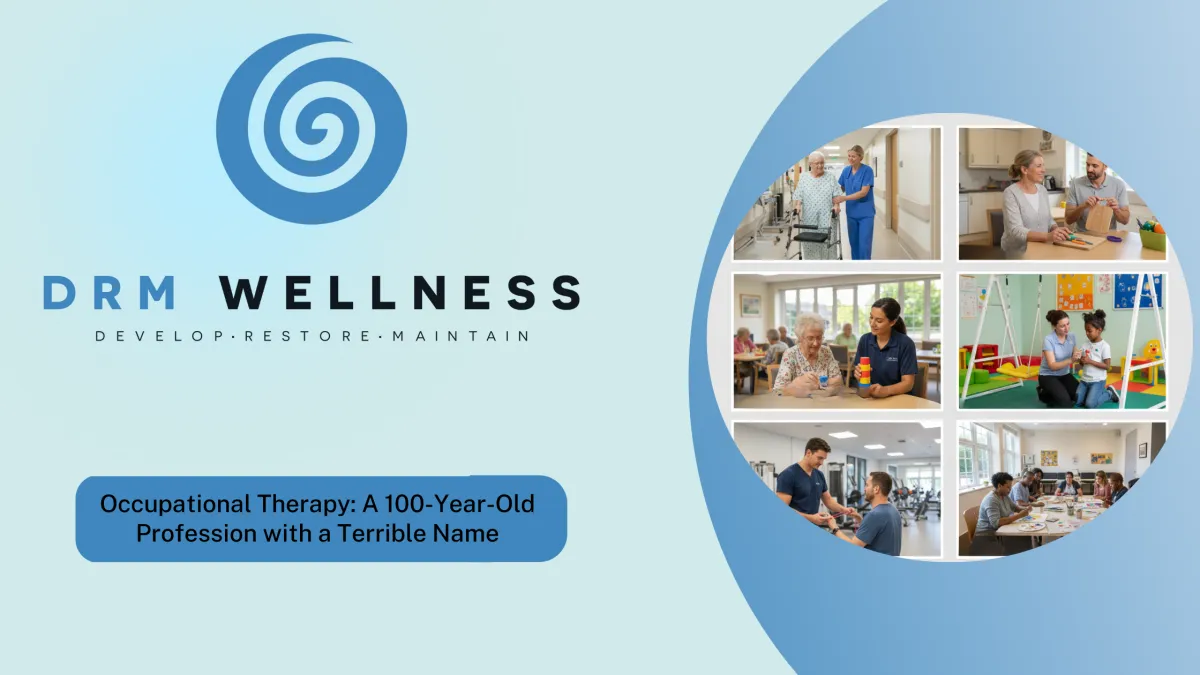
Occupational Therapy: A 100-Year-Old Profession with a Terrible Name
Occupational Therapy: A 100-Year-Old Profession with a Terrible Name
April is Occupational Therapy Month, so it feels like the perfect time to clear a few things up because if you’ve ever heard of occupational therapy and thought it had something to do with job placement, paperwork, or career counseling, you are definitely not alone.
We hear it all the time.
So let’s talk about what occupational therapy actually is, what we really do, and why it matters far more than most people realize.
A Little History Before We Clear Things Up
Occupational therapy didn’t start in a clinic. It didn’t start with billing codes or paperwork, and it definitely didn’t start with helping people find jobs.
Occupational therapy was founded more than 100 years ago with a simple but powerful belief. People heal better when they are able to engage in meaningful daily activities. Early OT pioneers understood that movement, routine, purpose, and participation were essential to both physical and mental health.
During World War I, occupational therapists worked with injured soldiers to help them regain function, independence, and a sense of normalcy. They used real-life activities to rebuild strength, coordination, and confidence so people could return to living, not just survive their injuries.
One of the profession’s early leaders, Eleanor Clarke Slagle, emphasized habit training, daily routines, and engagement in meaningful activities as core parts of health. The focus was never on employment. It was on life.
The word “occupation” originally meant what occupies your time. Dressing. Cooking. Caring for yourself. Moving through your home. Participating in your community.
Somewhere along the way, the name stuck, but the explanation didn’t, and that’s how we ended up with one of the most misunderstood professions in healthcare.
So before we celebrate Occupational Therapy Month, let’s clear something up.
No, occupational therapy is not about getting a job.
So What Is Occupational Therapy, Really
Occupational therapy is about helping people do the things that make up their everyday lives.
That includes basic tasks like getting dressed, cooking meals, and moving safely around the house. It also includes managing fatigue, reducing pain, improving balance, building endurance, and figuring out how to stay independent when your body does not work the way it used to.
OT looks at the whole person. Not just muscles or joints, but habits, environment, routines, confidence, and mental health. We care about how someone actually lives, not just how they perform in a clinic.
Once you understand that, occupational therapy starts to make a lot more sense.
Why the Name Still Trips Everyone Up
Occupational therapy has a branding problem. A big one.
The profession has evolved, expanded, and adapted over the last century, but the name never caught up. Most people never learn what OT really does unless they need it. Even then, it’s often explained quickly and without context.
That’s how we end up answering the same questions over and over.
Is this about jobs
Is this just for kids
Is this like physical therapy but easier
None of these questions are bad. They just highlight how much our profession has outgrown its name.
What Occupational Therapy Actually Looks Like Today
Modern occupational therapy shows up in real life.
It looks like helping someone improve balance so they can walk to the mailbox without fear. It looks like teaching strategies to manage pain and fatigue while staying active. It looks like adapting a home to reduce fall risk and support aging in place.
It also looks like building strength and endurance through functional movement that applies directly to daily life, not intimidating gym routines. It looks like supporting confidence, problem-solving, and mental health alongside physical health.
If something affects how a person lives their day, occupational therapy belongs there.
OT Is Growing Into Areas That Matter
Occupational therapy has always evolved to meet real-world needs, and that evolution is more important now than ever.
Today, OT is expanding into areas like preventive care, wellness, aging in place, mental health, community-based movement, pre and post-natal care, pelvic health and bariatric and plus-size care.
These are not niche areas. They are areas where people have been underserved, dismissed, or told to figure things out on their own.
OT was built for this kind of work.
What That Looks Like at DRM Wellness
At DRM Wellness, we practice occupational therapy the way it was always meant to be practiced.
We focus on function, movement, confidence, and real-world solutions. We often work with people in bigger bodies who have often been told to just lose weight without being given tools, support, or safe ways to move.
Weight loss is often a side effect of our work, but it is never the goal unless the client wants it to be. Our focus is mobility, endurance, balance, and independence.
We don’t shame. We don’t yell. We don’t push unrealistic expectations. We support, educate, and create an environment where people feel safe enough to try again.
That is occupational therapy.
We also bring that same philosophy to aging in place. We use Functional Capacity Evaluations for seniors to look at how someone truly functions in their daily life, not just how they perform on a single test. We assess strength, balance, endurance, mobility, and safety to help determine whether aging in place is realistic and what supports might be needed to make it successful.
Our goal is not to take independence away, but to preserve it for as long as possible. We don’t assume decline. We don’t rush decisions. We educate families, identify risks early, and create practical plans that support safety, dignity, and confidence at home.
We meet seniors where they are. We focus on ability, problem-solving, and real-world function. That is occupational therapy, and that is how we help people age in place with clarity instead of fear.
That is also occupational therapy.
Why Occupational Therapy Matters Right Now
Healthcare is very good at reacting after something goes wrong. A fall. A surgery. A hospitalization.
Occupational therapy shines in prevention.
When people move better, feel stronger, and understand their bodies, they avoid injuries, hospital stays, and long-term disability. They stay independent longer. They participate more fully in their lives.
That is not extra care. That is essential care.
So Yes, Let’s Celebrate OT
Occupational therapy may have a terrible name, but it has an incredible impact.
This Occupational Therapy Month, we celebrate a profession rooted in purpose, dignity, and real life. A profession that continues to evolve, adapt, and show up where people need it most.
So as we kick off Occupational Therapy Month, here’s your reminder to hug an OT. Or at least tell one you know what occupational therapy actually is. You truly have no idea how excited we get when someone says, “Oh, I know what that is.” It’s a small moment, but it feels like a win every single time.
And yes, we might cringe just a little when someone follows it up with, “That’s just like PT, right?” We love our PT friends, truly. We work alongside them every day. But occupational therapy brings its own magic. We look at life, function, routines, and independence in a way that’s uniquely OT.
So this April, celebrate the profession with the terrible name and the incredible impact. Hug an OT. Ask what we do. And if you already know the answer, just know you’ve made our day.
Happy Occupational Therapy Month.