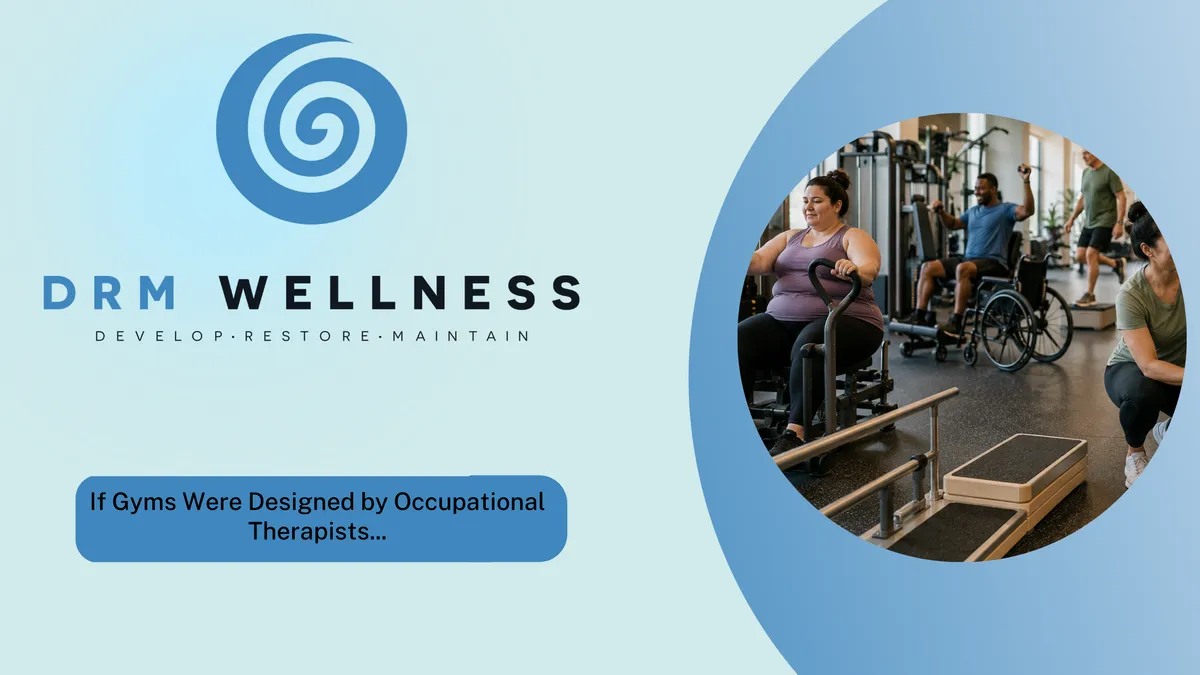
If Gyms Were Designed by Occupational Therapists
Most gyms weren't built for every body. What if they were?
I have a dream.
No, not the kind where I magically wake up loving burpees or running.
Let's be realistic.
I have a dream for a fitness space.
A place where people of all sizes, abilities, ages, and fitness levels feel comfortable walking through the front door.
A place where nobody worries if the equipment will fit.
A place where movement is celebrated, not judged.
A place where the goal isn't to create fitness influencers.
It's to help people live better lives.
At DRM Wellness, that's one of our long-term goals. Someday, we'd love to create a fitness and wellness space designed specifically for people who have never felt like they belonged in traditional gyms.
As an occupational therapist, I spend a lot of time looking at environments and asking a simple question:
"How can we make this work better for the people using it?"
Honestly…If occupational therapists designed gyms, they would probably look very different.
Let's take a tour.
First, We'd Stop Pretending Everyone Is the Same Size
Walk into most gyms and you'll find equipment designed for a fairly narrow range of body types.
Most people never think about this.
Others think about it every single time they exercise.
Can I fit comfortably on this machine?
Will the seat adjust enough?
Will the armrests get in the way?
What's the weight limit?
Can I get on and off safely?
If occupational therapists designed gyms, equipment would accommodate a wider range of body sizes and abilities from the start.
Not as a special feature.
Not as an afterthought.
Just as part of good design.
Because bodies come in different shapes and sizes.
Fitness equipment should too.
The Seating Wouldn't Be a Source of Anxiety
This sounds like a small thing until you've experienced it.
Many people walk into waiting rooms, fitness centers, meeting spaces, and public venues without ever thinking about where they're going to sit.
Others immediately scan the room.
Which chair is sturdy?
Which chair doesn't have arms?
Which chair will be comfortable?
Which chair can I get out of easily?
If occupational therapists designed gyms, seating would be comfortable, sturdy, accessible, and available in multiple sizes.
Nobody should have to worry about furniture before they can focus on their health.
There Would Be Private Workout Options
Let's address the giant mirrored elephant in the room.
Not everyone wants to exercise in front of an audience.
In fact, one of the biggest barriers I hear from people is the fear of being watched.
"What if I don't know what I'm doing?"
"What if people stare?"
"What if someone is filming their workout and I am in the back of it?"
"What if I look ridiculous?"
The reality is that most people are paying attention to themselves.
But anxiety isn't always rational.
If occupational therapists designed gyms, there would be private workout rooms, beginner spaces, and judgment-free areas where people could build confidence before stepping into larger group environments.
Because confidence often comes after people start exercising, not before.
Trainers Would Learn More Than Exercise Science
This one may be controversial.
A great trainer knows exercise.
An exceptional trainer understands people.
If occupational therapists designed gyms, every trainer would receive education on:
• Weight bias
• Chronic pain
• Mental health
• Trauma-informed care
• Adaptive exercise
• Mobility limitations
• Aging and functional fitness
Because not everyone walks into a gym with the same history.
Some people have spent years feeling judged.
Some are recovering from injuries.
Some are managing chronic conditions.
Some are simply terrified to be there.
Knowledge matters.
Compassion matters too.
We'd Create Functional Movement Zones
Traditional gyms focus heavily on exercise.
Occupational therapists focus heavily on function.
There's a difference.
Yes, strength matters.
Yes, endurance matters.
But ultimately, most people aren't exercising because they dream about using a leg press machine.
They're exercising because they want life to be easier.
If occupational therapists designed gyms, you'd find spaces dedicated to real-life movement.
Could you:
• Carry groceries?
• Get off the floor?
• Reach overhead safely?
• Climb stairs comfortably?
• Lift a laundry basket?
• Load a suitcase into a car?
These are the skills that support independence.
These are the skills people use every day.
And these are the skills many people care about most.
We'd Celebrate More Than Weight Loss
Imagine a gym where success wasn't measured by pounds lost.
Imagine celebrating things like:
• Walking farther
• Improving balance
• Getting off the floor more easily
• Climbing stairs without stopping
• Traveling comfortably
• Returning to hobbies
• Playing with children
• Feeling more confident
These victories matter.
In many cases, they matter more than the number on the scale.
There Would Be Fewer Mirrors and More Encouragement
Let's be honest.
Do we really need mirrors covering every square inch of wall space?
Occupational therapists would probably vote no.
Instead, we'd create spaces that feel welcoming.
Supportive.
Comfortable.
We'd focus less on appearance and more on capability.
Less on comparison and more on progress.
Less on perfection and more on participation.
The Goal Would Be Belonging
Here's the thing.
Most people don't avoid fitness because they don't care about their health.
Many avoid fitness because they don't feel like they belong.
They feel judged.
Intimidated.
Embarrassed.
Overwhelmed.
If occupational therapists designed gyms, the primary goal wouldn't be creating elite athletes.
It would be creating a place where people feel safe enough to begin.
Because once people feel accepted, amazing things happen.
They move more.
They get stronger.
They gain confidence.
They discover what their bodies are capable of.
The DRM Wellness Dream
At DRM Wellness, we believe movement should be for every body.
Not just the athletic body.
Not just the young body.
Not just the body that fits society's idea of fitness.
Every body.
Someday, we'd love to create a space that reflects that belief.
A place where people of all sizes and abilities can work on their health without worrying whether they fit in.
A place where function matters.
Where progress matters.
Where people matter.
Until then, we'll keep working toward that vision one client, one class, one conversation, and one step at a time.
Because most gyms weren't built for every body.
But someday, maybe ours will be.
