Blogs
“When health meets heart, the conversation begins, and it starts here.
Knowledge that empowers. Stories that connect. Support that matters.”
~ DRM Wellness
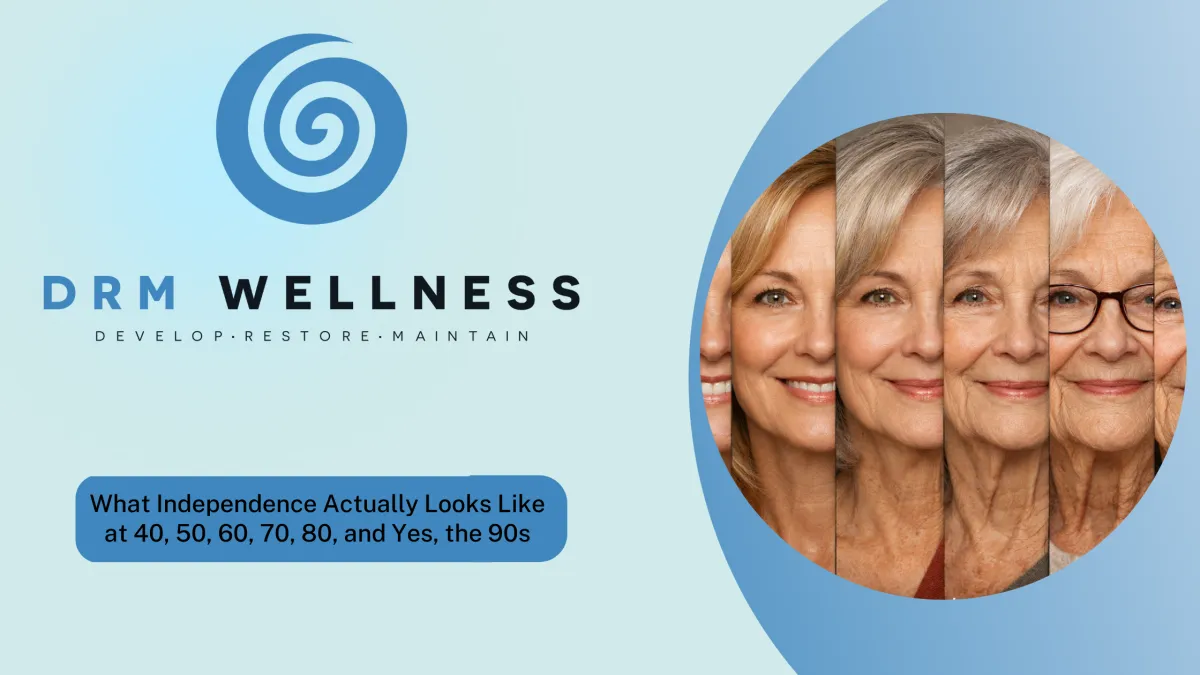
What Independence Actually Looks Like at 40, 50, 60, 70, 80, and Yes, the 90s
We talk a lot about independence, but rarely about what it actually looks like in real life. Here is our take….Realistic. Respectful. Slightly sweaty.
Independence is often marketed as a permanent state. You either have it or you lose it. One day you are “doing great,” and the next day someone is casually suggesting grab bars.
Real life is messier and far more interesting.
Independence changes shape over time. Bodies change. Hormones change. Energy changes. Priorities change. Pretending otherwise is how people end up frustrated, injured, or quietly exhausted while insisting everything is fine.
Independence at 40: Capable, Busy, Quietly Tired
Independence in your 40s usually looks strong from the outside.
Careers are demanding. Kids, parents, or both need attention. Schedules are full. Multitasking feels like a personality trait.
Behind the scenes, things start shifting.
Recovery takes longer than it used to.
Sleep quality becomes unpredictable.
Stiffness shows up after sitting too long.
Energy feels different, not gone, just less cooperative.
Many people chalk this up to stress or being busy. Some of it is. Some of it is also the body asking for better support, strength, and movement habits.
Independence here looks like meeting life’s demands without running on fumes or ignoring early warning signs.
Independence at 50: Hormones Enter the Chat
Independence in your 50s deserves its own category because perimenopause is real and it is not subtle.
Suddenly:
Sleep is unreliable
Joints complain without explanation
Balance feels off on certain days
Brain fog shows up uninvited
Fatigue has very strong opinions
Many people feel betrayed by their bodies during this decade. Nothing looks dramatically different, but everything feels harder.
Independence in your 50s is not about pushing through. It is about adjusting expectations, rebuilding strength in smarter ways, and recognizing that hormone changes affect balance, coordination, recovery, and confidence.
This is the decade where ignoring the body backfires the fastest.
Independence at 60: Still Capable, Slightly Negotiating
Independence in your 60s often looks outwardly unchanged. Work, travel, hobbies, and caregiving are still very much in play.
The negotiation becomes more obvious.
Low chairs get avoided.
Long days require recovery time.
Heavy tasks get broken into steps.
People start saying things like, “I can still do it, I just do it differently.”
That is not weakness. That is adaptation.
Independence here looks like maintaining enough strength, balance, and endurance to keep doing what matters without injury or burnout.
Independence at 70: Selective, Strategic, Confident
Independence in your 70s becomes more intentional.
Energy is treated as a resource, not an unlimited supply. People choose when and how to spend it.
Stairs are doable, but railings are appreciated.
Balance is reliable, but distractions are minimized.
Home layout suddenly matters in a very real way.
One person summed it up perfectly by saying, “I do not need to prove anything anymore.”
Independence here looks like confidence without unnecessary struggle.
Independence at 80: Supported, Thoughtful, Still Personal
Independence in your 80s is often misunderstood.
It is not about doing everything the hard way. It is about deciding what matters and making sure those things stay possible.
Movement may be slower, but it is deliberate.
Support is used strategically, not reluctantly.
The environment does more of the work so the body does not have to.
Many people in their 80s remain deeply independent because their homes, habits, and routines support them instead of challenging them.
True independence here often looks like conserving energy for what brings meaning and joy.
Independence in the 90s: Wildly Variable and Full of Surprises
Independence in the 90s is where assumptions about aging completely fall apart.
Some people hike regularly, attend yoga classes, and casually mention they just got back from a trip. Others need help with daily tasks and move more slowly to stay safe.
Both are normal.
One patient recently credited their longevity to a daily shot of whisky. The doctor, apparently, never argued. Another swore by gardening. Someone else credited stubbornness. One woman credited yoga and openly planned to outlive her enemies.
There is no single formula.
Independence in the 90s is not about doing everything alone. It is about how well the person, their body, and their environment work together.
Movement may be slower, but it can still be purposeful and strong. Decisions are intentional. Energy is protected. Support is used when it preserves autonomy, not when it threatens it.
What matters most is not the number of tasks someone can do, but how confidently and safely they move through their day.
Why the Gap Is So Wide in the 90s
The difference between a 90-year-old hiking and a 90-year-old needing daily assistance rarely comes down to luck.
It usually comes down to:
How well strength and balance were maintained earlier
Whether movement stayed part of daily life
How quickly environments adapted as needs changed
Whether support was used proactively or delayed until crisis
Small choices made decades earlier tend to show up loudly here.
That does not mean decline is a failure. It means aging is cumulative.
What Independence Is Not at Any Age
Independence is not refusing help.
Independence is not pushing through pain to prove a point.
Independence is not pretending nothing has changed.
Those patterns increase risk and quietly erode confidence over time.
The Common Thread Across Every Decade
Independence at every age relies on the same foundations.
Strength that supports daily life.
Balance that handles real movement, not just standing still.
Environments that reduce unnecessary effort and risk.
Habits that respect how the body works now.
The people who age best are not the ones who cling to how things used to be. They are the ones who adapt early and often.
What Actually Matters
Independence does not disappear at a certain birthday. It evolves.
Independence at 40 looks different than at 50.
Independence at 50 looks different than at 70.
Independence at 80 looks different than all of it.
None of those versions are failures.
They are simply different ways of living life on your own terms, with confidence, dignity, and far less unnecessary struggle.
That is what true independence actually looks like.

Take The Next Step with DRM Wellness
Testimonials
Get In Touch

Proudly Serving Omaha and the surrounding areas
MEDICAL DISCLAIMER:
All information on this website is intended for instruction and informational purposes only. The authors are not responsible for any harm or injury that may result. Significant injury risk is possible if you do not follow due diligence and seek suitable professional advice about your injury.
No guarantees of specific results are expressly made or implied on this website.
Copyright © 2025 All Rights Reserved by DRM Wellness.
Facebook
Instagram
LinkedIn
Youtube
TikTok