Blogs
“When health meets heart, the conversation begins, and it starts here.
Knowledge that empowers. Stories that connect. Support that matters.”
~ DRM Wellness
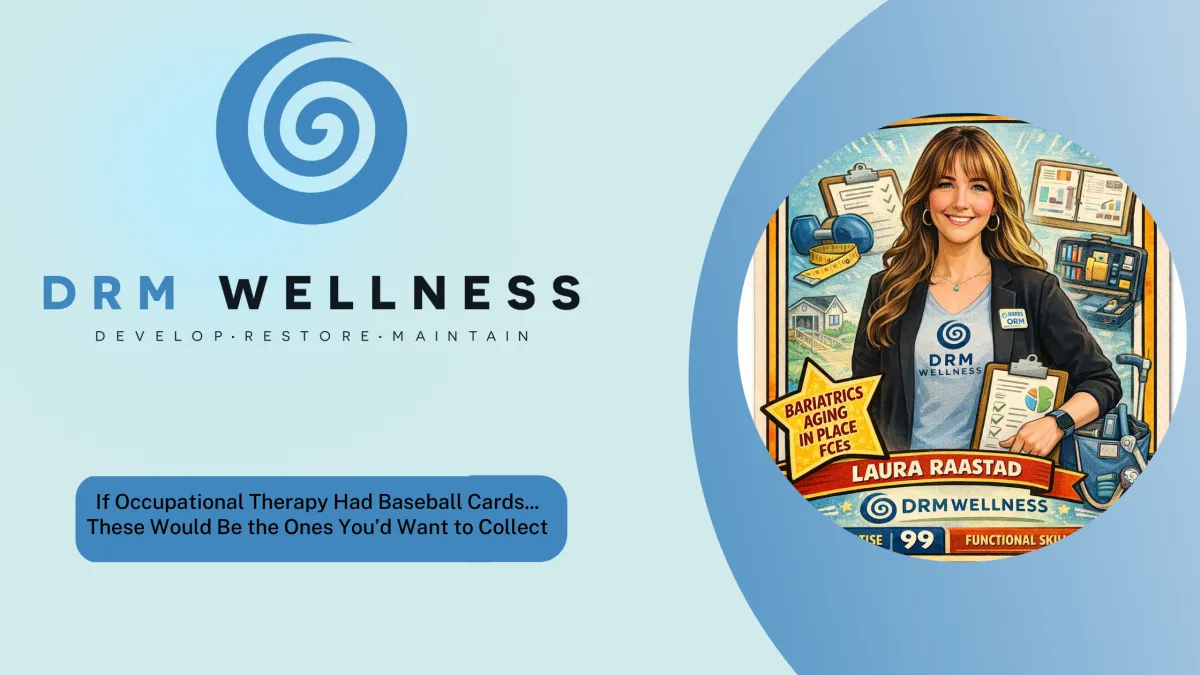
If Occupational Therapy Had Baseball Cards These Would Be the Ones You’d Want to Collect
Every profession has its legends. The people who changed the game, challenged the status quo, and shaped how the work is done long after they were in the room. Occupational therapy is no different.
If OT had baseball cards, the kind you kept in plastic sleeves and never traded away, these would be the ones worth collecting. Not because they were flashy, but because they fundamentally shaped how we think, treat, and show up as occupational therapists.
The OT Hall of Fame Starting Lineup
Teepa Snow
Teepa Snow changed the conversation around dementia care. She made it more human, more compassionate, and more functional. Her approach reminds us that behavior is communication and that dignity does not disappear with a diagnosis. She brought OT thinking into spaces that desperately needed it and made it accessible to caregivers, families, and clinicians alike. I swear one of these days, I am going to meet her in person.
Eleanor Clarke Slagle
Often called the Mother of Occupational Therapy, Slagle did not just practice OT. She defined it. She believed that habits, routines, and meaningful activity were essential to health. At a time when people were often confined and minimized, she centered function and participation. Every OT today is standing on the framework she built.
Gail Fidler
Gail Fidler brought depth to occupational therapy. She helped articulate the why behind what we do, especially in the areas of mental health, identity, and meaning. Her work reinforced that occupation is not just activity. It is tied to motivation, self concept, and purpose. She helped OT mature into a profession that values the whole person.
Florence Clark
Florence Clark helped elevate occupational therapy through research, education, and leadership. She pushed OT to be evidence based while still staying grounded in real life function. Her influence strengthened OT’s credibility in healthcare systems and academia, ensuring the profession had both heart and science.
Jean Ayres
Jean Ayres forever changed how we understand sensory processing. Her work gave language and structure to something many therapists intuitively saw but could not yet explain. Sensory integration theory opened doors for children and adults whose struggles were misunderstood or mislabeled. Her impact continues across pediatrics, mental health, and beyond.
These are the classic cards. The ones you never take out of the binder.
My Holy Grail Card and the OT I Absolutely Fangirl Over
Then there is Jeanette Reffstrup Christensen.
This is the point where professionalism quietly collided with internal chaos.
I found myself on a Zoom call with her and did my absolute best to appear calm, confident, and normal. On the inside, my brain was repeating one clear directive: do not say anything weird. She even told me I could use her first name, which somehow made the moment both better and worse.
She is, without question, my OT hero.
Jeanette is carrying forward the legacy of sensory integration while pushing occupational therapy into spaces that desperately need our voice, particularly obesity and weight related research. Her work is thoughtful, rigorous, and deeply rooted in occupational science. She does not oversimplify complex issues or reduce people to behaviors or outcomes. Instead, she examines participation, engagement, habits, routines, environments, and lived experience.
That matters.
What draws me to her work most is how clearly it aligns with the heart of occupational therapy. She blends theory, research, and clinical reasoning in a way that respects the complexity of human function. Her research asks better questions. Not just what changed, but how life participation changed. Not just outcomes, but meaning.
She is doing cutting edge work in areas like occupational participation following major weight changes, prevention of weight gain through occupation focused interventions, and large scale studies that integrate physical activity, sustainability, daily routines, and real life context. Projects like Danish obesity intervention trials, balance focused prevention studies, and participation driven research reflect exactly what OT should be contributing to this space.
Seeing an occupational therapist lead and publish in this area feels deeply validating for those of us passionate about bariatric and plus size care. It reinforces that this work belongs in OT and that it deserves serious, evidence based attention.
Some people fangirl over celebrities.
I fangirl over occupational therapists who make me think harder, practice better, and feel less alone in the work I care most about.
The Future Hall of Famers-OTs Blazing Trails Right Now
While it is essential to honor the giants who built the foundation of occupational therapy, it is just as important to recognize the OTs shaping the profession in real time.
One of the things I love most about occupational therapy is that it refuses to stay in a box. Our pioneers laid the groundwork, but an entire generation of occupational therapists is actively expanding what OT looks like, where it belongs, and how it shows up in the world.
These are the future Hall of Famers.
They are not waiting for permission or perfect conditions. They are building businesses, advocating for our scope, teaching the next generation, conducting research, publishing meaningful work, and pulling occupational therapy into spaces where it has long been needed but rarely invited.
This is OT in motion. Bold. Visible. Necessary.
Building Businesses and Supporting Entrepreneurship
Kara Welke is helping therapists build businesses and step confidently into entrepreneurship. She is showing OTs that it is possible to create sustainable, ethical, profitable practices without abandoning our values. Her work empowers therapists to see themselves not just as clinicians, but as leaders and innovators who deserve financial stability and professional autonomy.
This matters. When OTs thrive as business owners, the profession grows stronger.
Teaching, Advocating for OT and Securing a Seat at the Table
Melissa Kimmerling is doing critical work advocating for occupational therapy at a legislative level while she is educating new therapists as a professor and running a business. She is writing practice acts, pushing for clarity and protection of our scope, and making sure OT has a seat at the table when important decisions are made. This kind of work is often invisible to the public and even most therapists, but without it, the profession cannot move forward.
Advocacy is not optional. It is essential.
Teaching, Researching, and Advancing Bariatric and Obesity Care
Heather Locasha is shaping future therapists through teaching while also conducting research and publishing in the area of obesity and bariatric care. Her work is helping legitimize an area of practice that has long been ignored or oversimplified. She is helping build the evidence base that supports occupational therapy’s role in complex, weight-related health issues.
This is the kind of work that changes systems, not just individual outcomes.
Elevating OT Through Conversation and Visibility
Sarah Lyon has brought occupational therapy to a broader audience through her podcast, OT Potential. She draws attention to the depth, diversity, and impact of OT by having real conversations about practice, growth, and the future of the profession. Visibility matters, and she has helped make OT more visible, understandable, and respected.
When people understand OT, they value OT.
The Double Bonus Card
This is the double bonus card.
Megan Dooley and Rachel Wiley are not only incredible occupational therapists in their own right, they are actively changing the face of dementia care. Through the Context, Autonomy, Relationship, and Engagement (C.A.R.E.)™ Checklist and Framework they created, they have translated occupational therapy values into a practical, system-level tool that truly improves care.
The C.A.R.E.™ Framework centers what matters most in dementia care. Context acknowledges how environment and situation influence behavior. Autonomy reinforces dignity and choice. Relationship prioritizes connection over control. Engagement focuses on meaningful participation rather than task completion. Together, these elements shift care away from compliance and toward understanding.
This is occupational therapy doing double duty. Skilled clinicians and thoughtful innovators elevating care beyond individual sessions and into systems, giving caregivers and organizations a shared language rooted in dignity, function, and real-life participation. That is what makes this card such a standout in the collection and why their work is helping shape a better future for dementia care.
The Ultra Rare Bonus Card
Every collection has that one unexpected pull. The rare card. The one everyone notices immediately.
In a female-heavy profession, this is the highly sought-after guy card.
Steve Gluck is an occupational therapist, practice owner, and the creator and CEO of HelloNote, an EMR built for therapists, by therapists.
Steve saw a problem most clinicians were quietly tolerating and decided to fix it. Instead of working around clunky systems that were never designed with therapy in mind, he built one that actually understands how therapists think, document, bill, and run practices.
This is OT innovation in action. Clinician brain meets business savvy, with real-world experience driving better solutions.
So yes, this is the funny bonus card. The rare pull. The one male in the stack. But it is also a reminder that when occupational therapists see a need and step outside traditional roles, they can build tools that change how the entire profession functions.
Absolutely a card worth keeping in the collection.
The Rookie Cards You Want to Grab Now
These may not be the headline cards yet. They may not be hanging in frames or listed in history books, but if occupational therapy truly had baseball cards… these would be the rookie cards you would want to grab now.
Because they are the ones going to be worth a lot.
These are the occupational therapists who may not always be on big stages, but who are doing powerful, meaningful work every single day. They are building programs where none existed. Creating services their communities actually need. Figuring things out in real time. Taking risks. Asking better questions. Refusing to practice on autopilot.
They are pushing the profession forward in their own ways, in their own spaces, and often without much recognition.
And that is exactly how impact usually starts.
Years from now, these will be the names people point to when they talk about how occupational therapy evolved. The ones who saw what OT could become and started building it before it was popular or polished.
These might be the rookie cards.
But they are absolutely the ones worth collecting.
I am fortunate to call these ones my good friends. My colleagues. The people I travel to conferences with and text late at night when the questions start rolling in.
“What do I do here?”
“How can I write a better goal?”
“How do I bill for this?”
And just as often, “I’ve got you.”
There is no ego here, only genuine support. Shared ideas. Cheerleaders for the wins and steady support through the losses. These are the women who show up for each other and for the profession. The ones willing to take risks, ask hard questions, share what they have learned, and figure things out together. They support each other through uncertainty, celebrate wins big and small, and keep pushing occupational therapy forward in real, meaningful ways.
This kind of community is how change actually happens.
This is where I get to proudly shout out my OT friends.
Kristy Kaffko, Sarah Bagley, Nina Rea, Jennifer Huff, Tiffany Topp, Jennifer Kinkade, Kristen Hall, Stacey McIvor, Carly Rimes, Shannon Ruzicka and Krista Frahm, along with so many others, are doing the work that quietly but powerfully moves this profession forward.
They are building programs from the ground up. Supporting clients in meaningful, life changing ways. Mentoring peers who are finding their footing. Thinking outside the box to create small businesses and innovative services that did not exist before. They are pushing the boundaries of what occupational therapy has traditionally been and expanding what it can become.
This is what the future of OT looks like. Creative. Bold. Grounded in function and real life..and they are proving, every single day, just how powerful occupational therapy can be.
Not every trailblazer is loud. Not every impact is public. But it all matters.
Why This Deserves Attention During OT Month
Occupational therapy is not static. It never has been. From Eleanor Clarke Slagle to Jean Ayres, and from Teepa Snow to Jeanette Reffstrup Christensen, the profession has always evolved because people were willing to push it forward.
The OTs blazing trails today are continuing that legacy.
They are building businesses, shaping policy, advancing research, amplifying our voice, and reminding the world that occupational therapy belongs wherever real life happens.
Honestly, being part of this profession at this moment feels pretty incredible.
If OT had baseball cards, these would not just be collectibles. They would be reminders of what this profession stands for and where it is capable of going next.
And honestly, I cannot wait to see whose card gets added to the binder next.
Take The Next Step with DRM Wellness
Testimonials
Get In Touch

Proudly Serving Omaha and the surrounding areas
MEDICAL DISCLAIMER:
All information on this website is intended for instruction and informational purposes only. The authors are not responsible for any harm or injury that may result. Significant injury risk is possible if you do not follow due diligence and seek suitable professional advice about your injury.
No guarantees of specific results are expressly made or implied on this website.
Copyright © 2025 All Rights Reserved by DRM Wellness.
Facebook
Instagram
LinkedIn
Youtube
TikTok